

What Happens When the Gather and Stride Are Done Together

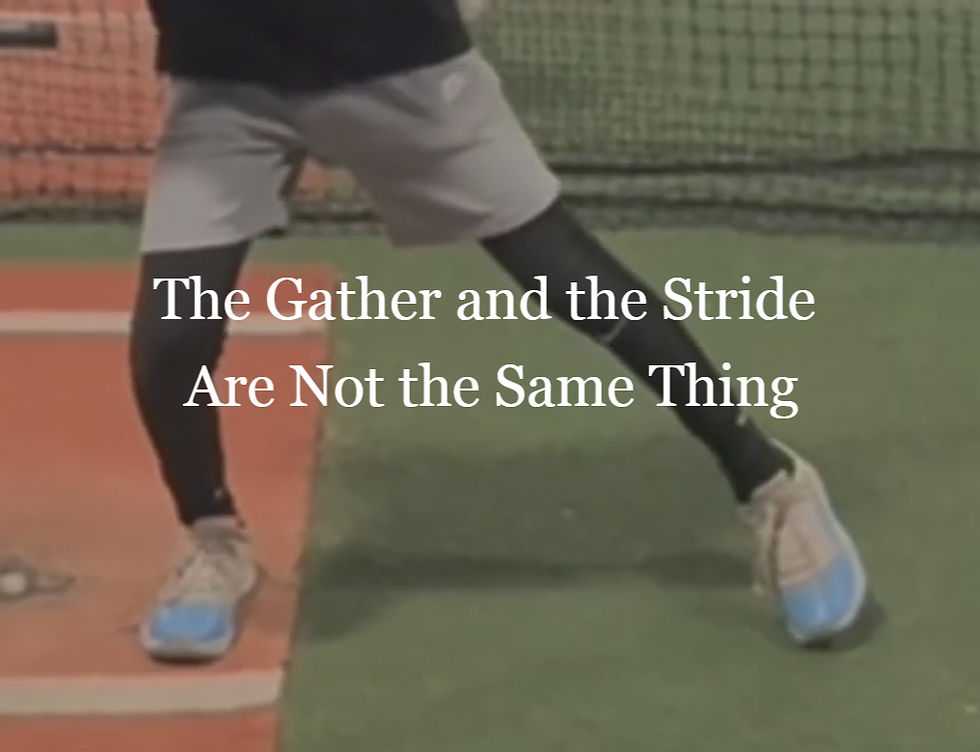
One of the most misunderstood parts of the baseball swing today isn’t bat path, launch angle, or even timing.
It’s the gather and the stride.
You hear instructors talk about these movements constantly. Social media is full of videos explaining “the load,” “the stride,” and “the move forward.” Many people claim to teach hitting, yet when you watch closely, something becomes clear very quickly.
Many instructors don’t actually understand the difference between the gather and the stride.
And when those two movements get blended together, hitters lose one of the most important elements of their swing, the power transfer.
The result is a swing that looks active but produces very little real force through the baseball.
The Gather Comes First
The gather is the hitter’s preparation phase. It happens before the stride and allows the body to organize energy for the swing.
During the gather, the hitter begins to load the rear side. The body coils slightly, the hands prepare and the hitter builds tension that will later be released into the baseball. Think of it like compressing a spring. The gather stores energy and prepares the body to move with rhythm as the pitcher delivers the ball.
Without a proper gather, hitters often rush their movement or start their swing too late.
The Stride Is the Move Forward
The stride is not the same thing as the gather. The stride is the controlled movement toward the pitcher that follows the gather. It allows the hitter to transfer energy forward while maintaining balance and direction.
When executed correctly, the stride places the hitter in a strong hitting position where the lower half can begin to rotate and deliver the barrel.
The gather prepares the body.
The stride delivers the body.
Two separate movements and two separate purposes.
What Happens When They Are Done Together
When hitters try to gather and stride at the same time, problems appear quickly. The most common issue is what many coaches refer to as a negative stride. Instead of moving forward into the pitch, the hitter’s energy remains trapped on the rear leg. The body never properly transfers forward and the swing loses both power and adjustability.
You’ll often see hitters:
stuck on their back leg
drifting forward late in the swing
losing connection between the lower half and the barrel
struggling to drive the ball consistently
The swing may still produce contact, but the hitter has difficulty generating real force through the baseball. Power requires movement and power requires transfer.
When the gather and stride collapse into one motion, that transfer disappears.
🎥 Video Demonstration: Gather vs Stride
Understanding the difference becomes much clearer when you see the movement in action.
Below are two demonstrations showing the difference between performing the gather and stride incorrectly and performing them in the correct sequence.
❌ Incorrect: Gather and Stride Together
In this example, the gather and stride occur at the same time. Instead of preparing the body first and then moving forward, the hitter tries to load and move simultaneously. This creates a negative move where the hitter’s power stays stuck on the back leg. The body never properly transfers forward and the swing becomes rushed and disconnected.
The result is a swing that often produces weak contact, poor adjustability and inconsistent power.
✅ Correct: Gather First, Stride Second
In this example, the hitter gathers first, loading energy into the rear side of the body. Once the gather is complete, the stride moves the body forward into a strong hitting position.
This sequence allows energy to move forward efficiently while maintaining balance and adjustability.
You’ll notice the hitter is able to:
move into the pitch with balance
transfer energy forward
The difference in sequencing may look subtle, but it dramatically affects how power is generated.
Why This Matters for Young Hitters
Young hitters are especially vulnerable to poor instruction because they are still developing coordination and body awareness. If they learn the wrong sequence early, it can take years to correct.
Teaching the gather and stride properly allows hitters to develop rhythm, balance and efficient power. It also helps them remain adjustable against different pitch speeds. In other words, it helps them become real hitters, not just good practice swingers.
Why This Is Often Taught Incorrectly
Part of the challenge today is the explosion of hitting instruction online. Social media has created a space where anyone with a bat and a camera can claim to be a hitting instructor.
Playing experience alone does not make someone a teacher. Repeating phrases like “load,” “stride,” and “separation” does not mean the movements are understood.
When instructors blur the difference between the gather and the stride, hitters are taught movements without understanding sequence. And when sequence breaks down, so does the swing.
The Teaching Cue
Sometimes the simplest cues are the best. Gather first. Stride second. When hitters understand this sequence, timing improves, balance improves and power begins to show up more consistently.
Final Thought
The gather and the stride are not the same movement. They serve different purposes and must occur in the correct order for the swing to work efficiently. When those movements are confused, hitters lose timing, power and adjustability.
Good instruction creates clarity.
Bad instruction creates confusion.
And in today’s world of endless swing videos and instant “experts,” hitters need clarity more than ever. Because the goal is not to look like a hitter. The goal is to actually become one.