

The 10 Commandments of Coaching Success

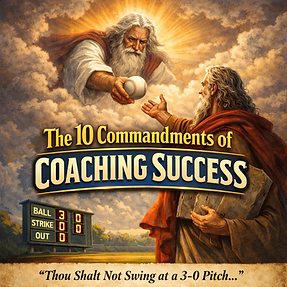
I came across a picture that stayed with me longer than I expected. God handing a baseball to Moses… and the message reads: “Thou shalt not swing at a 3-0 pitch.”
At first, it makes you laugh. It’s one of those lines that has lived in dugouts for decades, repeated by coaches at every level, passed down like it’s something that can’t be questioned. It feels like part of the foundation of the game, something that just “is,” but the longer you stay in baseball, especially as a coach, the more you start to see it differently.
That statement was never really about the swing. It was about coaching and more specifically, how coaching has been delivered for years.
Rules have been handed down without explanation, traditions have been protected without being challenged and in many cases, control has been mistaken for development. Over time, the meaning behind those “commandments” started to fade, leaving behind instructions without understanding.
Because real coaching success has never been about creating players who follow rules. It’s about developing players who understand the game well enough to make their own decisions when it matters most.
The First Commandment: Teach the “Why,” Not Just the Rule
The 3-0 take is one of the clearest examples of how a teaching point can turn into a rigid rule when context is removed.
Originally, it was meant to build discipline and awareness. It helped hitters understand count leverage, forced pitchers into the zone and taught them to value situations instead of simply reacting. There was a purpose behind it and when explained properly, it made complete sense.
Over time, the explanation disappeared and what remained was the rule itself. Players were told not to swing, not because they understood the situation, but because they were told that’s what you do. That’s where development starts to break down. When players are only given instructions, they begin to rely on direction instead of developing awareness.
They hesitate, they look to the dugout and they second-guess their instincts.
When you teach the “why,” everything changes. Players begin to understand the game, not just follow it. They recognize patterns, anticipate situations and make decisions with confidence instead of fear.
The goal of coaching is not to control every decision, it’s to prepare players to make their own.
The Second Commandment: Build Trust Before You Build Skill
Skill development means very little without trust. Players don’t fully commit to coaching unless they believe in the person delivering it and that belief is not built through systems or speeches. It is built through consistency, honesty and how you handle moments when things don’t go well.
Trust is developed in the small interactions. It shows in how you speak to players after failure, how you respond when they struggle and whether your standards apply to everyone the same way. Players notice everything, even the things coaches think go unseen. They see who gets patience, who gets attention and who gets overlooked.
Those details shape the environment.
When trust is present, players are willing to step outside their comfort zone. They accept coaching, they take risks and they grow because they know they are in a space designed for development rather than judgment. Without that trust, even the best information loses its impact.
Coaching is not just about what you teach, it’s about what players are willing to receive.
The Third Commandment: Coach the Individual Within the Team
Every player brings something different into the environment. Different personalities, different learning styles, different experiences and different timelines of development all exist within the same team. Some players respond to direct challenge, while others need encouragement to build confidence. Some learn quickly through explanation, while others need repetition and feel to understand what is being asked of them.
Recognizing those differences is part of effective coaching.
At the same time, coaching is not about individuals alone, it is about building a team that functions together. That balance is where coaching becomes more complex. You have to meet players where they are without lowering the overall standard. The environment has to feel fair, even if the approach is not identical.
Players do not need to be treated the same, they need to be coached with intention.
The Fourth Commandment: Don’t Let Ego Drive Decisions
Ego in coaching rarely shows itself in obvious ways, but its impact is significant when it does.
It can appear in the need to be right, in the refusal to adjust, or in decisions that are made to protect reputation instead of developing players. It can influence playing time, communication and even how feedback is delivered, often without the coach realizing it.
Players recognize it immediately.
They understand when decisions are based on performance and when they are influenced by something else. When that line becomes blurred, trust begins to break down and once it does, it is difficult to rebuild. Effective coaching requires self-awareness and the ability to step back from personal validation. It means being open to change, willing to listen, and focused on what benefits the player, not the coach.
Coaching is not about control, it is about responsibility.
The Fifth Commandment: Prepare Players for the Game, Not Just Practice
Practice environments can create a false sense of readiness if they are not designed with intention. It is easy to create controlled drills where players look sharp, make clean plays, and perform without much pressure. Confidence builds quickly in those settings, but that confidence does not always transfer when the game becomes unpredictable.
The reality of competition is different.
The game moves faster, situations change quickly and decisions have to be made without time to think. If players are not exposed to that in practice, they struggle to adjust when it matters most. Coaching success comes from creating environments that reflect the game, that means introducing pressure, forcing decisions and allowing mistakes to be part of the process. It means teaching players how to respond, not just how to perform.
The goal is not perfect execution in practice, the goal is preparation for reality.
The Sixth Commandment: Hold the Standard, Not Just the Lineup
Standards are easy to enforce when players are performing well, the real challenge comes when they are not. Every team has players with different roles, but expectations around effort, focus and accountability should remain consistent. When standards change based on talent or performance, players notice immediately and that inconsistency affects the entire environment.
Strong teams are built when players understand that expectations apply to everyone. It creates accountability within the group, where players begin to hold themselves and each other responsible instead of relying solely on the coach. Over time, that consistency shapes habits and reinforces what the program stands for.
That is how culture is built.
The Seventh Commandment: Understand the Moment
Baseball is a game built on situations and coaching within those situations requires awareness and feel. Not every moment is the same and not every response should be either. There are times when a player needs to be pushed and times when they need support. There are moments to be aggressive and moments to stay patient.
That same awareness applies to emotion.
There is absolutely a place in baseball for bat flips, celebrations and visible energy, especially when a player delivers in a meaningful situation and the team needs a spark. Those moments can shift momentum and bring life to a dugout in a way that nothing else can.
But context always matters.
Celebrating when the team is losing late in a game does not carry the same meaning and can take away from the moment rather than add to it. The goal is not to remove emotion from the game, but to help players understand when that emotion contributes to the team and when it does not.
That awareness has to be taught, it does not happen on its own.
The Eighth Commandment: Develop People, Not Just Players
Talent may create opportunities, but character determines what happens next. At the youth level, coaching has to go beyond performance. While skill development is important, it is only part of the responsibility. Coaches play a role in shaping how players think, how they respond to challenges and how they carry themselves both on and off the field.
Players who rely only on ability often struggle when the game becomes more demanding.
Failure increases, expectations rise and without the right habits and mindset, it becomes difficult to adjust.
That is where coaching must extend beyond mechanics.
Creating an environment where accountability, effort and respect are part of the daily standard helps players build a foundation that lasts beyond the game. Allowing them to experience struggle and work through it prepares them for situations where there is no immediate solution.
The objective is not just to develop better athletes, it is to develop individuals who can handle adversity and continue to grow.
The Ninth Commandment: Don’t Create Dependence
One of the most overlooked aspects of coaching is how easily dependence can be created.
When coaches are involved in every decision, every adjustment and every moment, players begin to rely on direction instead of developing awareness. It may feel productive in the short term, but over time it limits growth.
Development requires space.
Players need opportunities to make decisions, to experience failure and to learn from those experiences without immediate correction. That process is not always comfortable, but it is necessary for long-term growth. When the game speeds up, there is no coach making decisions for them, there is only the player and their ability to respond.
Coaching success comes from preparing them for that moment.
The Tenth Commandment: Don’t Chase Wins at the Expense of Development
Winning will always be part of the game, but it cannot become the only measure of success, especially at the youth level. When the focus shifts too heavily toward results, development often takes a back seat. Decisions begin to favor short-term outcomes, limiting opportunities for players to grow, experiment and learn through experience.
While this approach may create success in the moment, it can slow long-term progress.
Coaching success should be measured by development over time. It should be reflected in how players improve, how they respond to adversity and whether they are better prepared for the next level than when they started.
Winning should come as a result of development, not replace it.
Final Thought: The Commandments Were Never the Point
That image of Moses holding a baseball represents something that has existed in the game for a long time. Rules passed down without explanation, traditions followed without understanding, but the best coaches move beyond that.
They focus on building players who understand the game, who can think, adjust and respond in situations where there is no instruction coming from the dugout. Because in the end, coaching success is not about how well players follow your rules.
It is about how well they perform when they no longer need them.