

Some Teams Aren’t Avoiding Games… They’re Avoiding Being Exposed

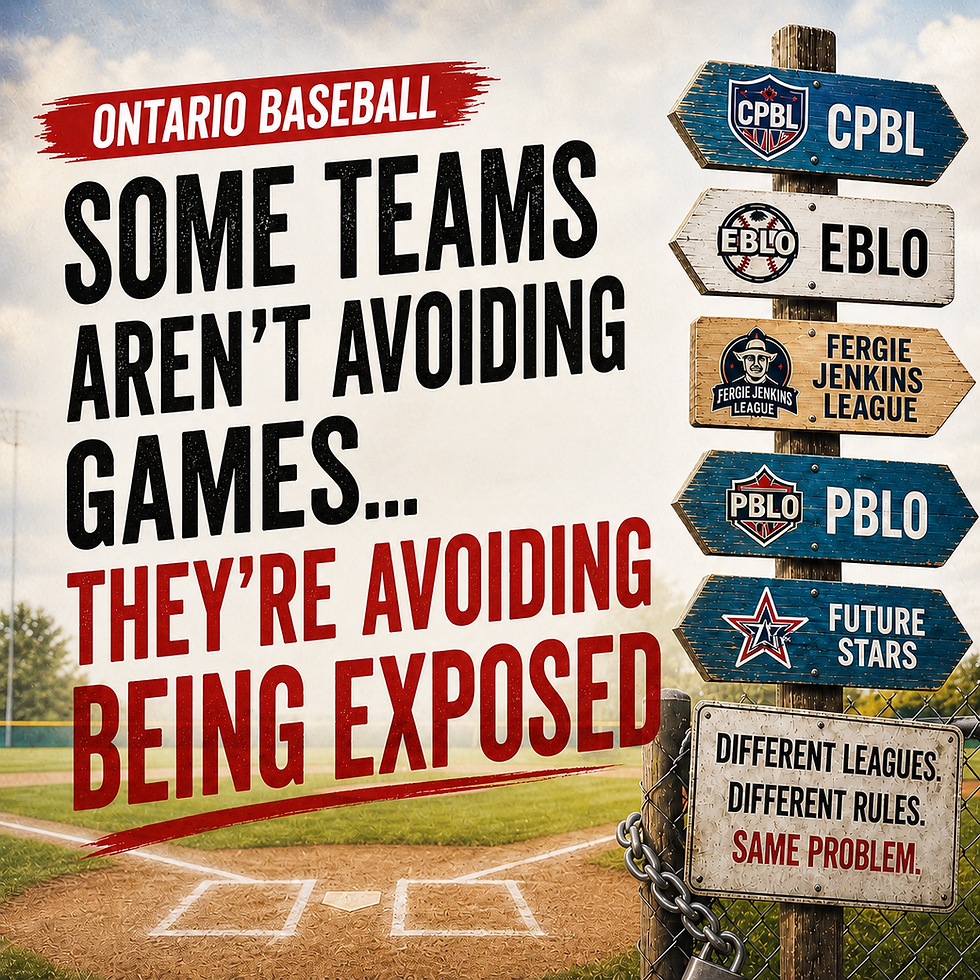
As the 2026 season begins across Ontario, teams are finally getting outside and into real games.
After months of indoor training, controlled environments, and structured reps, this is where everything is supposed to come together. Players feel ready, coaches feel prepared, and organizations begin showing what they built during the offseason.
But once the games begin, something becomes obvious very quickly.
Not everyone is playing the same game.
And the deeper you get into Ontario baseball, the more you realize some environments are built to challenge players while others are built to protect perception.
That’s where the conversation starts becoming uncomfortable.
The System Naturally Separates Teams
In Ontario, most organizations operate within their own league structures and competitive circles.
For the most part, teams stay inside those lanes throughout the season, repeatedly facing familiar opponents in familiar environments. On the surface, that makes sense. It keeps schedules organized and operations clean.
But development was never supposed to be clean.
It was supposed to be tested.
Because once teams stay isolated long enough, something important disappears from the process.
True comparison.
Teams begin measuring themselves against limited competition. Players repeatedly see the same arms, the same styles of play, and the same environments. Over time, perception slowly starts replacing reality because there are fewer opportunities to see how teams truly stack up outside their own circle.
And eventually, labels become easier to maintain than they are to prove.
The Games That Never Get Scheduled
The opportunities to create those matchups exist. Exhibition games can be arranged. Cross-league tournaments exist. Teams can challenge themselves if they truly want to.
But that willingness is not always there.
Because once those games happen, the label gets tested in a way that cannot be controlled anymore.
There’s no carefully selected matchup.
No protecting the narrative.
No staying inside an environment where everyone already believes the same thing.
It becomes just the game.
And sometimes that’s exactly what certain programs are trying to avoid. Not publicly.
Quietly.
In the games that somehow never happen.
When Competition Starts Becoming Political
There was a situation last year where multiple organizations from different environments were initially accepted into a tournament.
But once league affiliations and future alignment became known, those teams were suddenly no longer part of the event.
No real explanation.
Just a change.
And whether people want to admit it or not, moments like that contribute to the growing separation within Ontario baseball.
Because once competition starts being influenced by politics, affiliations, or business interests, the game slowly moves further away from what development is supposed to be about in the first place.
Competing.
That’s the frustrating part.
Not because every team needs to play each other constantly, but because some of the best opportunities for players to be challenged never happen at all.
And usually, the players are the ones who lose the most from that separation.
What I Saw Firsthand
From my own experience, the only consistent time we played private or for-profit organizations was when we traveled to tournaments in the United States. Once you crossed the border, there was no separation anymore.
You played whoever was in front of you and dealt with the result.
That’s real competition.
I remember coaching with West Toronto at the New Era Buffalo tournament. After pool play, we were sitting 4–0 and ranked first overall in the event. One of those games was against a highly respected Ontario organization, and we beat them 3–0 behind a one-hitter from our pitcher.
There was no buildup.
No politics.
No protection.
Just the game.
And honestly, those were some of the best development environments because players were forced into uncomfortable baseball. Nobody cared where you came from once the game started.
You either competed or you didn’t.
When It Happens Locally, It Feels Different
In Ontario, those opportunities have always felt different.
One of the few times we played a private team locally was during an exhibition game. During the game, recruiters from the opposing organization were speaking directly with our parents, handing out information and trying to bring players into their program.
We weren’t just playing against an opponent.
We were being recruited against.
That changes the environment immediately.
Because now the game is no longer only about competition. It becomes part competition, part business strategy.
And over time, that reality has become more common within Ontario baseball culture.
When the Results Don’t Go the Right Way
There was another situation where a team agreed to play us in fall exhibition games two years in a row.
We beat them both times.
After that, they no longer wanted to play us.
No explanation.
No follow-up.
Just silence.
And whether people want to admit it or not, situations like that tell you something.
Because if the real goal is competition and development, difficult games should be embraced, not avoided. Those are the games that expose weaknesses, force adjustments, and show players where they actually stand.
That’s where growth happens.
Unless protecting the image matters more than the challenge itself.
The Contradiction Nobody Talks About
This is where the conversation becomes difficult for certain organizations.
Because a lot of programs market themselves around words like:
exposure
elite competition
next level preparation
high performance
That’s the sales pitch.
Players and families are constantly being told they are preparing for environments where competition is difficult, uncomfortable, and unforgiving.
But if that’s truly the goal, then why are some of the same environments so careful about who they play?
That’s the contradiction.
Because exposure works both ways.
You cannot constantly promote the idea of challenging players while simultaneously controlling the situations that might challenge your own program.
At some point, the message and the actions stop matching.
And players eventually recognize that too.
Because real high-level baseball does not protect reputations.
It exposes them.
What Happens to Players Later
This is the part people miss.
Players usually don’t recognize protected environments immediately.
Sometimes they dominate inside them. Sometimes the rankings, records, social media hype, and labels convince them everything is progressing exactly the way it should.
Then eventually they leave that environment.
College baseball.
National tournaments.
Cross-border competition.
Older age groups.
And suddenly the game feels different.
The speed changes.
The depth changes.
The pressure changes.
Players who were rarely challenged before are suddenly being forced to adjust in real time against athletes who have been living in uncomfortable baseball for years.
That’s where the gap shows up.
Not because those players lacked talent.
Because they weren’t exposed to enough difficult baseball before they got there.
Controlled competition creates controlled development.
And eventually, the game exposes it.
What Are We Actually Protecting?
This is where the conversation needs honesty.
If a program truly believes it operates at a high level, then challenging competition should not be something it avoids. It should actively seek it out.
Because real development happens when players are forced into uncomfortable situations:
facing stronger arms
playing faster games
competing against unfamiliar opponents
dealing with failure
adjusting under pressure
That’s what prepares players for higher levels.
Not staying inside carefully managed environments where perception can survive without being fully tested.
Because eventually, every player reaches a level where protection disappears.
And when that happens, the game becomes honest very quickly.
Final Thought
There are good teams in Ontario.
There are strong programs, committed coaches, and talented players capable of competing at a very high level.
That’s not the issue.
The issue is whether the environment consistently pushes teams to prove it outside their own controlled circles.
Right now, too many meaningful matchups never happen. Too many programs are able to maintain reputations without regularly testing themselves against unfamiliar competition. And too many players are left believing they are fully prepared before the game eventually tells them otherwise.
If the level is real, it shouldn’t need protection.
It should show up anywhere.
And against anyone.